
Are we really so unique that standard IFS isn’t good enough?

We spoke with Christian Tidemann, Solution Architect at Align, about what upgrading to IFS Cloud really demands — based on personal experience and IFS Cloud upgrade projects at Align.

IFS Cloud is not just a technology upgrade. It demands a new way of thinking — and it is a significant shift for operational teams and consultants alike. Those of us who have spent years delivering tailored solutions now need to think and work differently.


What actually needs to change?

The mindset. For years the default has been: ”If it can be solved in IFS, we solve it there — with a customization.” With IFS Cloud, we need to flip that question: should this really be solved inside IFS at all?

Many processes feel unique simply because they have been that way for a long time — shaped by history, habits and old system limitations rather than real competitive advantage. So we should ask early:

Are we really so unique that standard IFS isn’t good enough?


If standard IFS supports a good process, we should consider changing the process rather than the system. That can be difficult. But if we want an evergreen solution, it is often necessary. Customizations are not only expensive to build. They are expensive to keep.


What does complexity actually cost?

The most common reason for customizations is legitimate: standard IFS doesn’t support the process the organisation wants to run. But every customization blocks your ability to adopt new IFS functionality — because new releases may conflict with what you’ve built. In practice, we risk coding ourselves back to a previous IFS version. ”Everything was better before” can become a self-fulfilling prophecy.

A more hidden problem is misuse of standard functionality. A spare field gets used for something it was never designed for — because it solved a problem at the time. Later, IFS delivers functionality that depends on that field being used as intended. What was once a quick fix suddenly becomes a blocker.

That is not just technical debt. It is functional debt.

Customizations cost you future opportunities — and a customization is not fully paid for when it goes live.


What about complex configurations — aren’t those safer?

Not necessarily. In older IFS versions, customers couldn’t write customization code themselves — so advanced configuration was the fast, flexible workaround. That was the right choice at the time, and explains why so many complex configurations exist today.

In IFS Cloud, you own the code. That changes everything. Complex configurations — events, custom LUs, migration jobs — are effectively hidden customizations. Fragmented, poorly documented, and often nobody remembers why they were created. They can be even harder to keep evergreen than actual code.

They look like standard — but behave like bespoke development. If a customization is justified, build it properly. Don’t hide it in configuration.


What if standard IFS genuinely doesn’t cover the need?

Then ask whether IFS is even the right place to solve it. Keep IFS as the core — but don’t force it to become everything. Two approaches often work better than customizing inside IFS:

  1. A dedicated UI on top of IFS – Instead of customising IFS screens for a specific user group, build a simple purpose-built interface using standard IFS projections and APIs. IFS does the heavy lifting in the background — the interface is loosely coupled and unaffected by new releases
  2. App-to-app integration via standard APIs – Do we already have systems that solve the need better? Let them talk to each other. Map visualisation is a good example — IFS has map functionality, but for organisations where maps are central to daily work, a dedicated mapping tool will often be better. It can pull data directly from IFS via standard APIs, display it on the map, and let users initiate work orders from there — with zero customization inside IFS. Each system does what it does best.


So what’s the bottom line?

Zero customizations is a utopia for most organizations. Some needs are real, and some customizations are justified. But every one you keep must have a clear business case — not only for development, but for the full lifecycle. What does it cost to test, maintain and upgrade? For most organizations that means regression testing once or twice a year. If no one can defend that cost, retire it.

Design the solution for the next release — not only for go-live. That is when you start thinking evergreen.


Christian Tidemann

Solution Architect, Align Consulting AS

Online Deliveries are now for real!

Online Deliveries are no longer a discussion; it is a reality – Suzuki Garphyttan and Align Consulting celebrating the successful IFS Cloud 25R2 implementation

Align Consulting (“Align”) has successfully delivered the IFS Cloud 25R2 release update with the new Delivery Continuity feature for Suzuki Garphyttan (“SG”), a global automotive manufacturer with production sites in the US, Mexico, UK, Germany, Sweden, and an implementation of the  site in China. With operations running 24/7, it is virtually impossible for SG to find a maintenance window that does not impact at least one site, making low‑downtime deployments essential.

Twice a year, in May (1) and November (2), IFS releases (R) a new version. The latest available is hence from last year (2025) and there you have the naming logic: 25R2. The lift to IFS Cloud 25R2 was planned, coordinated and executed by consultants at Align. This release marks a major step in IFS Cloud’s evolution, introducing EBR (Edition‑Based Redefinition) compliance with a revised technical architecture that simplifies future upgrades by facilitating Online Deliveries. Align supported SG through the full 25R2 transition, ensuring that all customizations and integrations remained intact while complying with the new architecture.

A key element of the project was SG’s decision to utilize the new Delivery Continuity feature, introduced in 25R2, which supports online deliveries with significantly reduced downtime. During the first online delivery, the actual downtime was only 15 minutes, enabling SG to maintain production across its global sites with almost no disruption—a major milestone for a continuous‑manufacturing environment.

SG’s IFS solution is complex, with multiple customizations built into the solution. Despite this complexity, the team delivered the 25R2 upgrade within the initially agreed timeline along with high quality, receiving strong feedback from SG on the overall process. The system has now been running on 25R2 for more than a month without any major distributions, demonstrating the stability and quality of the deliverables. The experience has also set a ground for future efficency through AI capabilities.

Align also had really good collaboration with IFS during the project through the Pioneer Program, a special initiative to support early‑adopter customers on the latest 25R2 release. Working closely with IFS through this program allowed the team to apply quick fixes, leverage early guidance, and help SG get the most out of the new 25R2 capabilities from day one.

For global high-tech manufacturers like SG, upgrading IFS Cloud must be predictable, safe, and aligned with continuous production. This project illustrates how the combination of EBR‑ready architecture, a structured Pioneer‑level engagement and competent partner collaboration can deliver a complex cloud upgrade with minimal disruption and maximum business value.

Independent Application Management for IFS Cloud – Built Around Your Needs

Many companies using IFS Cloud need help with their day-to-day operations; not the least doing updates or making changes to the system.  

At Align Consulting, our Application Management Services (AMS) are designed to ensure your IFS Cloud solution remains: 

  • stable  
  • updated 
  • continuously aligned with business needs


Regardless of how or where your solution is hosted

Application Management – Independent of Hosting Model 

Align’s Application Management Services are not dependent on how IFS Cloud is hosted. Whether your solution is hosted by IFS Cloud Services or deployed in your own environment, Align can play a key role in ensuring that IFS Cloud, integrations, and modifications operate smoothly and deliver real business value. 

Full Application Management – Even with IFS Cloud Services 

If your solution is hosted by IFS Cloud Services, IFS takes care of technical platforms, such as servers, databases, backups, and system availability.  

Customers who choose IFS Cloud Services often assume that application management is fully covered. Hosting and application management are very different activities and the customer is still responsible for how the application is used, updated, and adapted to business needs

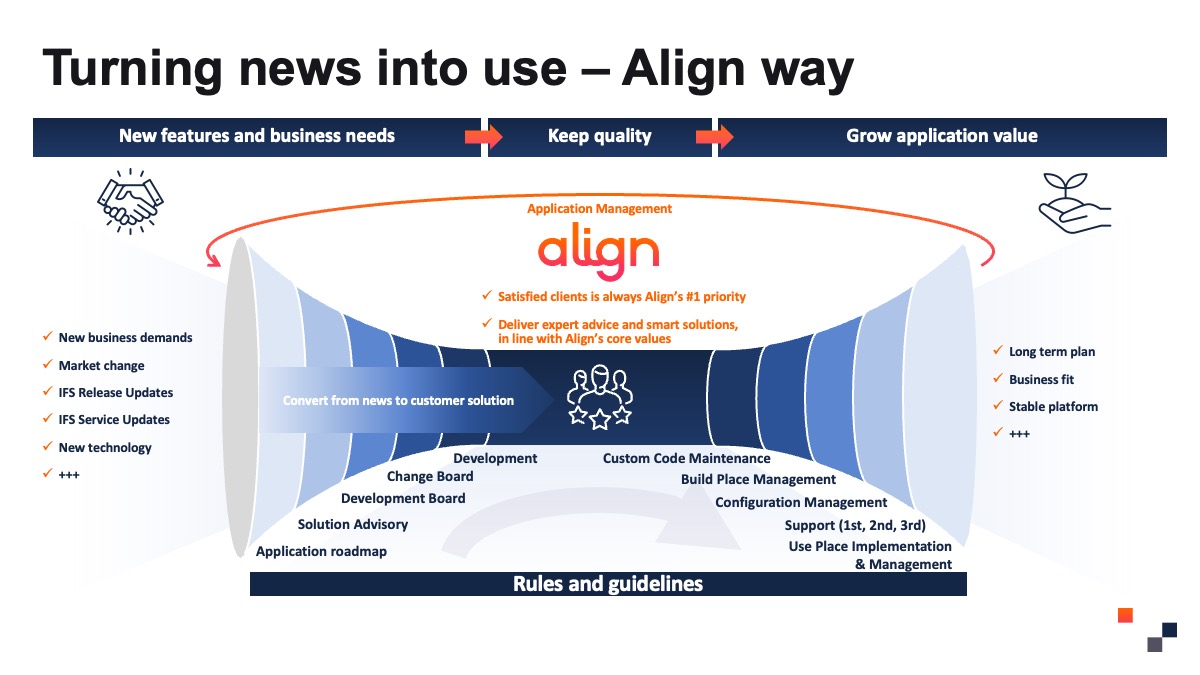
Align Consulting can provide comprehensive application management services on top of IFS Cloud Services, including: 

  • Full lifecycle management, including Build Place administration, implementation of release and service updates and CRIM development
  • Planning, coordination and ticket handling for IFS Cloud Services environments. 
  • Align Monitoring Solution for IFS Cloud 
  • Code review 
  • Automated testing (regression testing) 


This ensures your IFS Cloud solution remains reliable, optimized, and aligned with both short-term operational needs and long-term strategy. 

Lifecycle Management and Custom Code You Can Trust 

A core strength of Align’s Application Management Services is lifecycle and custom code management.  

We proactively plan, coordinate, and execute activities that keep your solution evergreen while safeguarding upgrade compatibility. 

Our services include: 

  • Build Place administration and governance 
  • Review and implementation of IFS release and service updates 
  • Proactive planning aligned with business cycles 
  • CRIM development covering configurations, reports, integrations, and modifications 
  • Quality assurance, regression testing, and automated testing support 


With bi-annual IFS Cloud releases, structured lifecycle management is essential. Align ensures that every change is documented, tested, and future-proof. 


Flexible Deployment and Hosting Support 

Align Consulting can also assist customers with remote deployment of IFS Cloud. Depending on your needs, we can: 

  • Take full responsibility for hosting your IFS Cloud solution 
  • Assist with setting up and governing hosting in your own environment 


This flexibility allows you to choose the deployment and hosting model that best fits your IT strategy. 


Value-Added, Align-Developed Offerings 

As a customer, you benefit from Align-developed tools that strengthen quality, stability, and performance: 

  • Code Review – A structured quality gate ensuring secure, performant, and upgrade-safe customizations 
  • Align Monitoring Solution for IFS Cloud – Proactive monitoring and analysis of key application and integration functions 
  • Automated Testing – Supporting regression testing and release readiness 


These offerings reduce risk, improve predictability, and free up internal resources. 

Your Independent Partner – Always on Your Side 

Working with Align as an independent partner ensures that our focus is always on your best interests. We are not tied to a specific hosting model or delivery approach. Our services are: 

  • Tailored to your requirements 
  • Aligned with your business priorities 
  • Governed through transparent processes and clear roles 
  • Delivered with long-term sustainability in mind 


With Align Consulting as your Application Management partner, you gain control, confidence, and a future-ready IFS Cloud solution – no matter how it is hosted. 


Want to learn more? Contact Align Consulting to explore how our Application Management Services can be tailored to your IFS Cloud landscape.


The Blue Trip 2025 – A Tradition of Togetherness

A surprise trip into the unknown. No revealed destination, no known plans—just a packing list, a sense of adventure, and the promise of unforgettable moments together. That’s the magic of the Blue Trip – our cherished Align family tradition.

Each September, anticipation builds as we gather from all corners of the company: from Oslo and Stockholm, Linköping, Copenhagen, Bergen and Sri Lanka.

For a few incredible days, we step away from our everyday roles and routines to reconnect, share experiences and blends work and private life in a nice mix, recharge, and rediscover the essence of who we are—together. Thereby facilitating future collaborations and adding even more value to our customers.

This year’s destination? The breathtaking coastal gem of Marina di Pulsano, Italy. With its crystal-clear waters, sun-drenched beaches, and warm hospitality, Pulsano captured our hearts from the very first moment. Days basking in 25+ degree warmth, swimming in turquoise seas, and evenings filled with laughter and connection created a perfect setting for this year’s adventure.

Among the highlights:

  • A visit to the beautiful Masseria Borgo dei Trulli, where we explored local wine traditions and shared a toast to the year behind us and the journey ahead.
  • Relaxing beach days, where time slowed down and friendships grew deeper.
  • The unforgettable Align Games, where teams competed with heart and humor—and one team earned gold and bragging rights until September 2026!


But the Blue Trip is about so much more than the destination. It’s about culture. It’s about values. It’s about people. In a company like ours, where colleagues work across offices, countries, client locations, and home setups, the Blue Trip provides a rare and powerful opportunity to bring everyone together. To see each other not just as coworkers, but as friends. To laugh. To dance. To share stories and create new ones.


These moments shape us. They build bonds that carry into our daily work, enriching our collaboration and reinforcing the culture that makes our company truly special.

As we return to our routines, we carry with us more than memories—we carry the spirit of the Blue Trip. A spirit of unity, joy, and shared purpose.

Here’s to the stories we created, the friendships we strengthened, and the adventures still to come. Until next time🧡

Why Code Review Matters

At Align Consulting, we support our customers by providing technical review and quality assurance for IFS modifications delivered by third parties. As part of this, we offer a structured code review process to validate solutions developed by IFS, or other vendors, before they are delivered to the customer’s environments.

This service is currently being delivered to Wilhelmsen Ships Service (WSS) – a distinguished leader in the maritime industry. While IFS is responsible for the development, Align Consulting acts on behalf of WSS to perform independent code reviews, ensuring all deliverables are technically sound, functionally accurate, and ready for production deployment. In addition to WSS, this structured code review service has gained strong interest from other key customers in the industry.

What Our Customers Say

“We would like to extend our sincere thanks to Nadeesha De Silva for your valuable support in reviewing the code developed by our vendor. Your involvement played a crucial role in ensuring the quality, reliability, and maintainability of the solution.

The review was thorough, insightful, and constructive. She demonstrated strong technical expertise, identifying key areas for improvement and offering practical suggestions that significantly enhanced the overall code quality. You were prompt in communication, collaborative in your approach, and maintained a professional and solution-oriented mindset throughout the process.

The feedback not only helped us address immediate concerns but also contributed to improving the coding standards and document best practices. We look forward to continued collaboration and highly recommend for any code review or technical advisory roles.” 

Sri Kanth Mudhireddy— Technical Architect, Wilhelmsen Ships Service

Why Code Review Matters in IFS Projects

IFS Applications often involve complex business logic, multi-module dependencies, integrations with external systems, reporting, and configurations. Reviewing custom code is critical to:

  • Ensure stability across application upgrades
  • Avoid performance issues in production
  • Align modifications with IFS development standards
  • Align modifications with other underlined technologies such as Oracle, PL/SQL, Java
  • Maintain compatibility with IFS upgrades and patches


The Shift with IFS Cloud: Why Customers Need to Take More Responsibility?

With the transition to IFS Cloud, there has been a significant shift in code ownership. Unlike traditional on-premise setups where IFS or IFS partners often managed the full development lifecycle, IFS Cloud empowers customers to own and maintain their custom code directly within the cloud environment.

Because of this shift:

  • Customers are now responsible for the long-term quality, performance, and upgrade safety of their modifications.
  • Poorly reviewed or non-compliant code can impact the entire IFS environment, including integrations and future upgrades.
  • IFS Cloud follows a frequent release cadence, and unreviewed modifications increase the risk of incompatibilities or unexpected failures after updates.
  • Code review becomes not just a quality control step, but a key practice in sustainable solution ownership.


Therefore, it is essential for customers to take an active role in reviewing and governing their custom code as part of owning their IFS Cloud solution ensuring that solutions are robust, future-proof, and aligned with both technical and business requirements.

Our Structured Review Approach

  • Verify functional correctness – Ensure the implemented logic aligns with business requirements and handles edge cases appropriately.
  • Enforce coding standards – Validate adherence to relevant coding guidelines based on the technology used such as Oracle PL/SQL, Java, and IFS Best Practices to ensure readability, consistency, and long-term maintainability.
  • Improve performance – Identify inefficient logic, unnecessary loops, redundant calls, and PL/SQL operations that may degrade system performance or increase resource consumption.
  • Enhance security – Detect and prevent common security issues such as SQL injection risks, improper handling of user input, and missing validation checks.
  • Ensure maintainability – Promote modular, well-structured code that is easy to support, extend, and debug in future enhancements.
  • Act as a pre-release quality gate – Serve as the final technical checkpoint before the solution is delivered to the customer environment, helping reduce post-deployment issues.
  • Use of AI and Cloud-Based Tools for Smarter Reviews – At Align, we believe effective code review goes beyond manual inspection. We use modern tools such as ChatGPT (OpenAI Official Tool), Copilot with Visual Studio Code, JMeter + Azure Load Testing, etc. to enhance quality, accelerate feedback, and ensure production readiness.


What You Gain from Align Consulting’s Code Review Process

  • Confidence that modifications meet both business logic and technical standards
  • Reduced post-go-live issues and support overhead
  • Improved performance and system responsiveness
  • Enhanced security and risk mitigation
  • Faster time-to-value and smoother release cycles
  • Lower long term maintenance cost through clean, consistent code
  • Seamless future upgrades with minimal modification breakage


Ready to learn more?

Book a meeting with us today to dive deeper into our code review practices and discover how they can be adapted to your organization’s IFS landscape. Whether you’re planning a major release, handling complex modifications, or simply aiming to improve code quality, we’re here to support you every step of the way.

We look forward to helping you deliver reliable, scalable, and upgrade-safe IFS solutions with confidence.


Align blir en del av CombinedX-familjen 

På IFS-marknaden i Sverige och Norge har vi på Align skaffat oss en stark position och ett rykte som “kundens oberoende partner”. Där vi samarbetar med alla som önskar göra våra kunders vardag bättre. 

Idag kan vi med glädje, stolthet och en stor portion nyfikenhet på framtiden, berätta att vi ytterligare stärker våra möjligheter att kunna bidra till våra kunder. Detta genom att bli en del av CombinedX (CX).  

 CX är en familj av kunskapsbolag, samtliga specialister inom sitt område, som hjälper företag att dra nytta av digitaliseringens alla möjligheter. Via oss på Align gör CX sin entré på IFS-marknaden. CX är noterade på den svenska börsen, och står liksom vi för enkla, genuina, skandinaviska värderingar, med kunder och medarbetare i fokus. På riktigt. 

Align förblir Align, precis som idag. Med fokus på IFS. Med vår kultur, vår identitet, med ödmjukhet, värme och glimten i ögat. Inga radikala förändringar således. Men, där CX-familjen ger mer muskler och dito möjligheter. Både för dig som kund och för oss som medarbetare.  

 Detta ser vi fram emot! 

Pressmeddelande ifrån CombinedX

Läs mer om CombinedX

Lösningsarkitekten som driver förändring – Birgitte om Evergreen och framtiden

I en värld där utveckling sker snabbt och kundernas behov blir mer komplexa spelar lösningsarkitekter en avgörande roll. Birgitte Hanstad, en erfaren lösningsarkitekt med fokus på IFS Cloud, delar sina insikter om hur Evergreen ställer ännu högre krav och hur rollen som rådgivare blir allt viktigare för att hjälpa företag att navigera i det nya IFS landskapet.

Mer än en problemlösare – en strategisk rådgivare

”Vi är inte bara här för att lösa problem – vi är rådgivare. Vi utmanar gamla arbetssätt och hjälper kunder att fatta strategiska beslut för framtiden. Det handlar om att se helheten och optimera verksamheten på ett sätt som håller långsiktigt.”

Hon betonar vikten av att ifrågasätta traditionella metoder och att alltid ha ett kritiskt förhållningssätt till befintliga processer:

”Ska vi verkligen göra så här? Finns det bättre sätt? Kan vi använda standardfunktionalitet? Vår uppgift är inte bara att utföra en uppgift, utan att skapa verkligt värde. Vi vill säkerställa att kunden får en lösning som fungerar både idag och i framtiden.”

Evergreen förändrar spelplanen

Införandet av IFS Cloud och Evergreen har inneburit en stor förändring för både kunder och konsulter. Tidigare arbetade många företag med långa uppgraderingscykler, men nu sker uppdateringar kontinuerligt.

”Evergreen innebär att förändring är en konstant faktor. Kunder kan inte längre lämna allt åt leverantörerna och hoppas på att deras system ska fungera oförändrat i flera år. De måste aktivt hantera sin kodförvaltning och kvalitetssäkring för att säkerställa att nya releaser fungerar optimalt. Det är en stor omställning, men också en möjlighet att arbeta mer proaktivt.”

Hon ser en tydlig trend där företag behöver optimera sina processer och minska anpassningar (CRIM) för att kunna dra nytta av den nya modellen:

”Det handlar inte bara om kod utan om att förstå affärsprocesser och att verkligen använda den nya funktionaliteten som tillkommer i varje release. Företag som anpassar sig till detta sätt att arbeta kommer att ha en stor konkurrensfördel.”

Evergreen kräver långsiktigt tänk – och mod att utmana

Med den nya uppdateringsmodellen blir långsiktigt tänkande viktigare än någonsin.

”Vi måste göra val idag som inte begränsar oss imorgon. Ingen vet exakt hur verksamheter ser ut om 5–10 år, men systemen måste vara flexibla nog att anpassa sig. Det innebär att vi måste tänka framåt vid varje beslut – hur påverkar detta möjligheten att ta in ny funktionalitet? Riskerar vi att låsa oss fast i gamla arbetssätt?”

Hon poängterar också att konsultens roll blir ännu viktigare i detta nya landskap:

”Den bästa konsulten är inte den som alltid säger ja till kundens önskemål, utan den som vågar säga nej – och förklara varför. Det krävs mod att stå fast vid sin rådgivning och leda kunden i rätt riktning, även om det innebär obekväma beslut.”

Närhet och helhetssyn – det som gör skillnad

Många av de tekniska lösningarna är desamma oavsett om de kommer från IFS eller en partner, men enligt Birgitte är det arbetssättet som skiljer sig mest.

”Vi i Align erbjuder mer än bara implementation – vi är en långsiktig partner för våra kunder – vi är nära kund”. Vi tar oss tid att förstå deras verksamhet på djupet, vi ställer de viktiga frågorna och vi bygger långsiktiga relationer. Det gör att vi kan ta ett större ansvar och hjälpa kunden att göra rätt val, inte bara på kort sikt utan för framtiden.”

Framtidens lösningsarkitekt – en strategisk partner

Med den ökande digitaliseringen och Evergreens kontinuerliga uppdateringar blir lösningsarkitekters roll allt mer strategisk. Birgitte ser en tydlig utveckling där teknisk kompetens måste kombineras med en djup förståelse för affären.

”Vår roll blir alltmer strategisk. Vi behöver förstå tekniken men också kunna guida kunderna i att fatta rätt beslut. Det handlar inte längre bara om att få systemen att fungera – det handlar om att skapa en struktur i och runt affärssystemet som stödjer verksamheten på lång sikt. Det är där vi gör verklig skillnad.”

Elvia och Align nyttjar möjligheterna i IFS Cloud

Elvia är Norges största nätbolag och ansvarar för att nästan två miljoner människor har el i sina uttag.

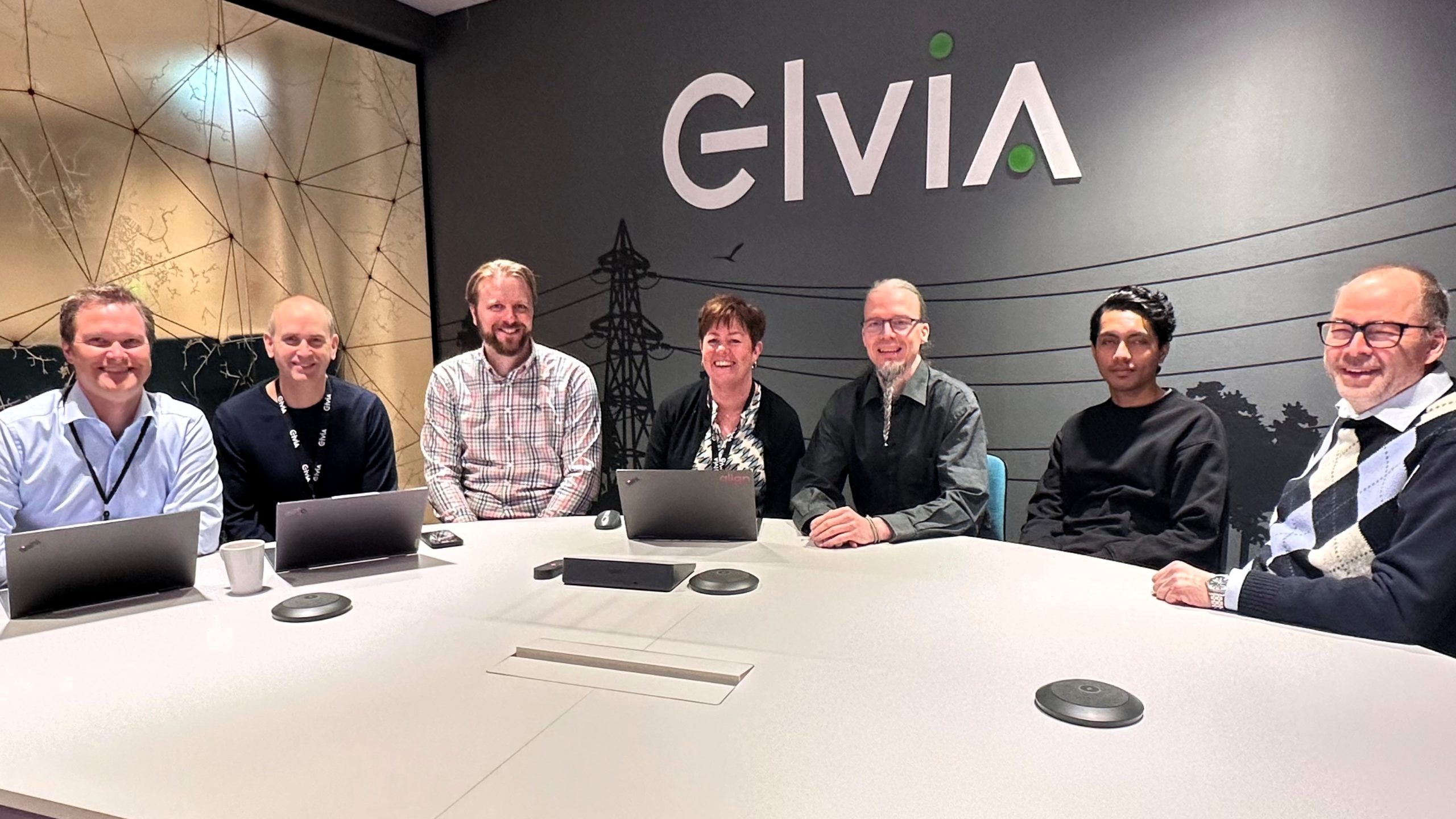
Align har sedan många år ett nära samarbete med Elvia, och i övergången till IFS Cloud har Align haft förmånen att hjälpa till genom förstudie till projekt och nu i den efterföljande förvaltningen av IFS Cloud. Align stöttar Elvia med helheten i allt från lösningsarkitekt, affärskonsulter, teknik samt utvecklare till build place hantering.

En god förvaltning av IFS Cloud kräver några viktiga principer;

  1. Alla aktörer i ekosystemet bör kunna bistå med CRIM (anpassningar och konfigurationer).
  2. Lösningen ska vara framtidssäker och ”evergreen”, vilket innebär att anpassningar bör ske utanför applikationens kärna för att underlätta uppdateringar och ändringar.
  3. Elvia ska kontinuerligt ligga i framkant av den tekniska utvecklingen och säkerställa ständiga förbättringar genom projekt, releaser och uppdateringar.


En av de viktigaste förändringarna med IFS Cloud är användningen av RestAPI:er som möjliggör förbättringar utanför själva källkoden. Enkelt uttryckt kan alla applikationer som stöder REST API nu enkelt kommunicera med IFS Cloud utan större anpassningar, t.ex. genom hjälp av standardiserade low code-lösningar.

En viktig aspekt av samarbetet är att Aligns lösningsarkitekt är en integrerad del av en större arkitektgrupp på Elvia. Med sin specialisering inom IFS Cloud, arkitektur och metodik har lösningsarkitekten spelat en central roll i att vägleda Elvia kring sina egna affärsbehov och hur dessa bäst kan lösas – antingen inom ramen för IFS, genom alternativa system eller i Elvias egenutvecklade lösningar.

I denna process har Aligns utvecklare också arbetat nära utvecklare från andra företag, både för att analysera möjligheter i IFS och för att utveckla optimala lösningar med hjälp av RestAPI:er. Detta samarbete har varit och kommer att vara avgörande för att utveckla och implementera innovativa lösningar utan större anpassningar och genom detta se till att IFS Cloud-lösningen förblir evergreen i form av regelbundna uppdateringar. Denna strategi är nyckeln till att maximera värdet av IFS och förbättra dess förmåga att möta framtida behov.

Vi på Align ser fram emot att uppnå nya strategiska samt taktiska mål tillsammans med Elvia.

Collaboration for success!

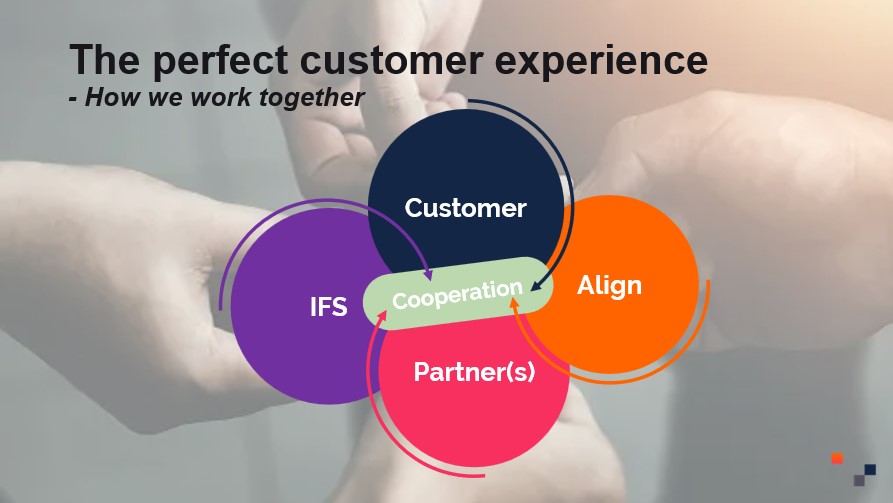
IFS Cloud innebär valfrihet, men också ett ökat ansvar för dig som kund. Du måste göra viktiga val när du hanterar din IFS-lösning, både på kort och lång sikt. I tidigare versioner av IFS kunde det vara svårt att få fler partners att samarbeta kring ens IFS-lösning, särskilt när det gäller anpassningar av applikationen. IFS Cloud ger dig som kund möjlighet att sitta i förarsätet och bjuda in fler att arbeta tillsammans, sida vid sida. I IFS Cloud äger du som kund lösningen samt dess anpassningar.

Hur navigera rätt?

Vilken väg just du som kund bör gå beror på flera saker: egen kompetens, strategi, verksamhetens behov, förändringstakt m.m. En viktig fråga blir vad ska vi göra själva och vad vill vi lämna till andra? Vill du själv kunna styra och ha kontroll, med en hög grad av engagemang av dina egna resurser, eller vill du överlåta ”så mycket som möjligt” till en eller flera partners? Svaren på dessa frågor kommer att avgöra vilken samarbetsmodell som väljs, både för projekt och förvaltning. Om du vill kunna förvalta lösning själv är det viktigt att bygga kompetens, och ta ansvar, redan i projektet.

IFS Cloud har en ny arkitektur. Med denna kommer en ny viktigt fråga, där lösning kommer att hanteras i ”Build Place” och användas i ”Use Place”. Vad ska placeras, var och hur säkerställs kvaliteten på helheten? Och hur hanterar man uppdateringar till nya versioner på ett effektivt sätt?

En eller flera partners? Vilken är rätt modell för dig?

  • Att ha en leverantör med monopol är bra, förutsatt att leverantören är vass på allt du behöver och dessutom ger dig sitt fulla fokus
  • Att ha flera leverantörer kan vara mer krävande men ökar flexibilitet samt tillgången till stöd


Varför är samarbete med flera viktigt?

Align har goda erfarenheter av att sätta upp ramar och spelregler och därmed lägga grunden för lyckade projekt och framgångsrik förvaltning, där flera partners samverkar.

Detta blir extra viktigt i en så kallad ”evergreen” strategi, vilken möjliggör snabba och enkla uppdateringar till nya versioner.

Vilken typ av samarbetsmodell ska du välja? Det finns inget rätt svar, inget svar som är rätt eller fel. Du behöver finna den väg som passar dig och ditt företag bäst. Det viktigaste är att göra en bedömning och göra ett medvetet val.

Align har lång erfarenhet av att hjälpa kunder att definiera spelregler och ramverk för projekt och förvaltning där flera parter arbetar tillsammans. Vi ser att allt fler kunder upplever ett ökat värde genom samarbete med andra. Det får även flera att vara på tå.

Lycka till!

Samarbeten kring IFS affärssystem

IFS Cloud är affärssystemsleverantören IFS namn på sina senaste versioner av sin programvara. Genom sin moderna och öppna arkitektur har IFS sinnrikt givit sina kunder ännu större möjligheter att faktiskt använda så många olika samarbetspartners man så önskar.

Det där kan såklart låta bättre än det är. Är det alltid en fördel med många samarbeten för en kund? Absolut inte, inte för alla. Att ha en och samma partner till “allt” inom ERP, ja kanske inom hela IT-området, kan absolut ge fördelar. Har du en riktigt bra motpart får du snabb och kostnadseffektiv support och proaktiv vidareutveckling av någon som verkligen kan din verksamhet. Du får högsta prioritet. Väntetiderna blir korta.

Vi tror dock att det är många som tyvärr inte riktigt upplever att det vi just beskrev stämmer med verkligheten. Är du en kund som ser förbättringspotential inom något område tror vi det är relevant och klokt att söka olika samarbeten. Då väljer du, för att måla exempel i IFS-världen, kanske ett bolag som din IFS-licenspartner, ett annat som din förvaltningspartner, ett tredje som stöttar dig i din mottagarorganisation och ett fjärde som din integrationspartner. Dessutom kontaktar du kanske något enskilt orakel du hört talas om som expert på just området du har utmaningar inom. Osv. Du kan givetvis göra fler, och helt andra, val än så.

Men, blir det inte knepigt med ansvarsfördelningen då? Det blir det absolut. Om du inte beskriver vem som ansvarar för vad. Det gör du exempelvis med stöd av enkla s.k. ansvarsmatriser, där vi själva förordar varianten som kallas RACI. Gör du detta med de involverade parterna ökar sannolikheten för framgång avsevärt. Att på så sätt använda de individer och företagskulturer du gillar, som passar din stil, dina värderingar och dina verksamhetsbehov, är mer möjligt än någonsin med IFS nya arkitektur. Ta chansen att testa. Börja i liten skala. Det är kul och givande med samarbeten!

Not: Detta med samarbeten filosoferade vi och vår kund Profoto mer kring på IFS skandinaviska användarförenings träff i Solna den 22 november samt det virtuella mötet den 8 februari. Missade du det?

Vill du veta mera? Vi berättar gärna!